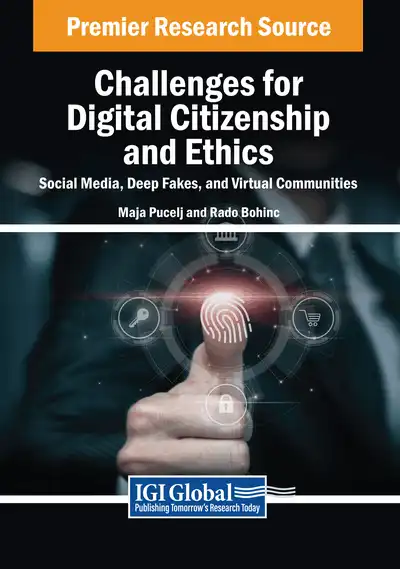
Challenges for Digital Citizenship and Ethics: Social Media, Deep Fakes, and Virtual Communities

Authors: Maja Pucelj (EMUNI University, Slovenia) and Rado Bohinc (EMUNI University, Piran, Slovenia) Release Date: October, 2024
Buy a Book

The integration of human rights, social responsibility, and technical innovation acquires significant importance in the current era of digital transformation. As technology rapidly evolves, it profoundly influences societal structures, economic systems, and individual lives. It is essential to examine the impact of digital transformation on human rights and social responsibility, and emphasize the importance of striking a balance that upholds individual rights while leveraging technological advances for the benefit of society as a whole.

Challenges for Digital Citizenship and Ethics: Social Media, Deep Fakes, and Virtual Communities analyzes the implications of digitalization on human rights and social responsibility. By adopting a multidisciplinary approach, this research combines perspectives from the fields of digital ethics, information technology, law, and social sciences. It examines the impact of digital technologies on privacy and data rights, assess the strategies utilized by corporations in the digital age to uphold human rights, and explore the policy and legal frameworks required to assure the ethical adoption of technology. Covering topics such as cybercrimes, digital literacy, and societal dynamics, this book is an excellent resource for policymakers, sociologists, researchers, academicians, educators, students, and more.
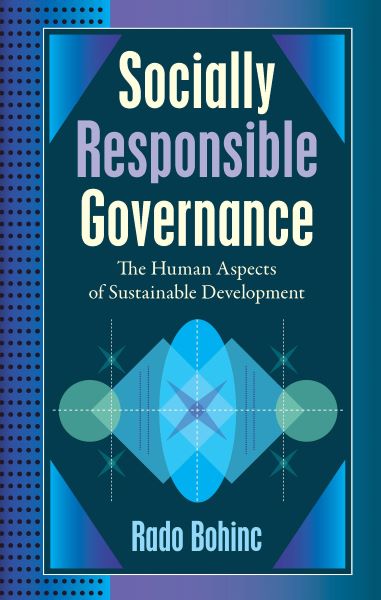
SOCIALLY RESPONSIBLE GOVERNANCE

Author: dr. Rado Bohinc,The Human Aspects of Sustainable Development. ISBN: 978-961-295-083-5 (Fakulteta za družbne vede, Založba FDV)

This book brings together in one place the author’s key insights into the social and human aspects of sustainable governance and social responsibility. It presents some alternative models for more inclusive and effective governance approaches at both the societal and corporate levels. It addresses issues such as corporate social responsibility, the duties and responsibilities of shareholders and directors, cooperative, employees, and social enterprises, the structural and financial participation of employees in corporate governance, and more.

The social dimension of governance issues, such as corporate and social responsibility, social dialog, the welfare state, etc., has its philosophical roots in human ethics and its legal basis in the constitutional paradigm of human rights and freedoms.

In modern society and in corporations that are characterized by significant developments in the field of information and communication technologies and other digital technologies, both capital gain and human/social aspects should form the
framework for democratic life and social welfare. The new information and communication channels influence the balance between the two fundamental components of modern societies and corporations, namely capital and labour.

Corporations and Partnerships in Slovenia, Second edition

Author: dr. Rado Bohinc, Published by: Kluwer Law International, 2020

Buying a book

Derived from the renowned multi-volume International Encyclopaedia of Laws, this practical analysis of the law of business formations in Slovenia provides quick and easy guidance on a variety of corporate and partnership considerations such as mergers, rights and duties of interested parties, stock exchange rules, labour laws, and takeovers. Lawyers who handle transnational business will appreciate the explanation of local variations in terminology and the distinctive concepts that determine practice and procedure.

A general introduction covering historical background, definitions, sources of law, and the effect of international private law is followed by a discussion of such aspects as types of formation, capital, shares, management, control, liquidation, mergers, takeovers, holding companies, subsidiaries, and taxation. Big companies, various types of smaller entities, and partnerships are all covered in turn. These details are presented in such a way that readers who are unfamiliar with specific terms and concepts in varying contexts will fully grasp their meaning and significance.

Thorough yet practical, this convenient volume puts the information necessary for corporations to compete effectively at the user’s fingertips. An important and practical tool for business executives and their legal counsel interested in engaging in an international partnership or embarking on corporate expansion, this book will prove a valuable time-saving tool for business and legal professionals alike. Lawyers representing parties with interests in Slovenia will welcome this very useful guide, and academics and researchers will appreciate its value in the study of comparative business law.

Media Law in Slovenia, Second edition

Author: dr. Rado Bohinc
Published by: Kluwer Law International, Alphen aan den Rijn cop. 2019

Buying a book

Derived from the renowned multi-volume International Encyclopaedia of Laws, this analysis of media law in Slovenia surveys the massively altered and enlarged legal landscape traditionally encompassed in laws pertaining to freedom of expression and regulation of communications. Everywhere, a shift from mass media to mass self-communication has put enormous pressure on traditional law models.

An introduction describing the main actors and salient aspects of media markets is followed by in-depth analyses of print media, radio and television broadcasting, the Internet, commercial communications, political advertising, concentration in media markets, and media regulation. Among the topics that arise for discussion are privacy, cultural policy, protection of minors, competition policy, access to digital gateways, protection of journalists’ sources, standardization and interoperability, and liability of intermediaries. Relevant case law is considered throughout, as are various ethical codes.

A clear, comprehensive overview of media legislation, case law, and doctrine, presented from the practitioner’s point of view, this book is a valuable time-saving resource for all concerned with media and communication freedom. Lawyers representing parties with interests in Slovenia will welcome this very useful guide, and academics and researchers will appreciate its value in the study of comparative media law.

Corporate Social Responsibility

Authors: dr. Rado Bohinc, dr. Til Rozman, dr. Matjaž Uršič, Petra Podobnikar, Maja Jančič, dr. Barbara Rajgelj
Published By: Fakulteta za družbene vede, Založba FDV, Ljubljana, 2016

Buying a book

When talking about social responsibility on a global level, every entity doing activities in a relationship with nature shall maintain balance between the economy and the ecosystems. In addition, balance should be searched between the profit and social welfare, or, speaking on a wider scale, between economic and social development. A trade-off shall be achieved between two desirable but incompatible features; or, to be less ambitious, at least a compromise.

Continue reading “Corporate Social Responsibility”

Media law in Slovenia

Author: dr. Rado Bohinc
Editor: Rogers Blanpain, Frank Hendrickx,Published by: Kluwer Law International, Alphen aan den Rijn cop. 2015

Buying a book

In the first part of the book, there is an overview of media markets and landscape in Slovenia and main actors in the field of public and private radio broadcasting and print media. Also technical infrastructure as electronic communications network, equipment, services, including electronic signature and cable penetration are analysed. In addition, institutional infrastructure like Electronic Communications Council of the RS, Communications Networks and Services Agency, ACOS (APEK) and The Inspectorate of the RS for Electronic Communications and Electronic Signature are presented. Following technological and economic developments on the media markets is introduced as digital television, new media, convergence of media products and film and audio-visual industry are described in the book. Sources of media law starting with the Constitution, legislation and implementation decrees, related to media and to broadcasting and journalist ethical codes and case law from the field are further elaborated.

Continue reading “Media law in Slovenia”

Corporate governance as a tool for economic growth

Authors: dr. Rado Bohinc (ed.), dr. Mejra Festić, dr. Vesna Dizdarević, dr. John Hopkins, dr. Jožef Mencinger, dr. Matjaž Nahtigal, dr. Barbara Rajgelj, dr. Bojan Tičar, dr. Katja Eman, published by: Založba FDV, Ljubljana 2014
Authors of this book are from two Slovenia’s universities (University of Ljubljana, University of Primorska) and from the University of Canterbury, New Zeeland.
The book is based on the research project, financed by the Agency for Research and Development of the RS, number J5-4233, duration 1.7.2011 – 30.6.2014 called: CORPORATE GOVERNANCE AS A TOOL TO OVERCOME WORLD ECONOMIC AND FINANCIAL CRISIS. The research was dealing with the roots and consequences of the world economic and financial crisis, focusing on the factors of economic growth, related to corporate governance and some macroeconomic issues. As for domestic factors, important factors of efficiency, effectiveness and competitiveness have to do first of all with the transition issues, like unfinished or unimplemented parts of reforms of the legal, economic and political system. Even more, there are serious gaps between enacted legal system solutions and reality in business and politics, due to weak enforcement system on one hand and strong and deeply entrenched previous business ethics and practices on another.

Continue reading “Corporate governance as a tool for economic growth”

Comparative company law : an overview on US and some EU coutries’ company legislation on corporate governance

Author:  dr. Rado Bohinc, Published by: VDM Verlag Dr. Müller, Saarbrücken2014, cop. 2011, 529 pages, 537 legal sources.

Buying a book

The US and EU Comparative Company Law monograph contains the extensive research the author has done on the corporate governance systems of the USA, EU, UK, Germany, France, Slovenia and some other countries of the EU and out of EU. It analyses the differences and similarities, advantages and disadvantages, of the US single board or one-tier system in comparison with the European two-tier corporate governance systems. Following an in-depth presentation of corporate governance in general, provided with chapters on the general theory on corporate governance, the main opened issues of corporate governance, sources of law, OECD principles of corporate governance and OECD guidelines for state owned enterprises, the book focuses on the types of business organizations and ownership structures both in the US and EU corporations, and then concentrates on explaining and analysing the corporate governance systems in the EU, the USA, the United Kingdom, Germany, France and Slovenia, emphasising the features inherent to each of these systems.

Continue reading “Comparative company law : an overview on US and some EU coutries’ company legislation on corporate governance”
Zavrnitev piškotkovSpletna stran za nemoteno delovanje in čim boljšo uporabniško izkušnjo uporablja piškotke. Če se strinjate z našo politiko piškotkov, pojavno okno zaprite s klikom na znak x desno.